There is no fee unless we win!
EN

- EN
- ES



The rise of remote work has created new questions about workplace injury protection. If you're working from home in Washington State and suffer an injury while performing job duties, you need to understand: Does workers' comp for remote employees provide the same protection as traditional workplace coverage? The answer involves complex legal considerations, but remote workers generally do qualify for workers' compensation benefits when injured during work hours while performing job-related tasks.
If you've been injured while working remotely, the experienced Seattle workers' compensation lawyers at Lehmbecker Law can help you navigate the complexities of filing a claim and ensure you receive the benefits you deserve.
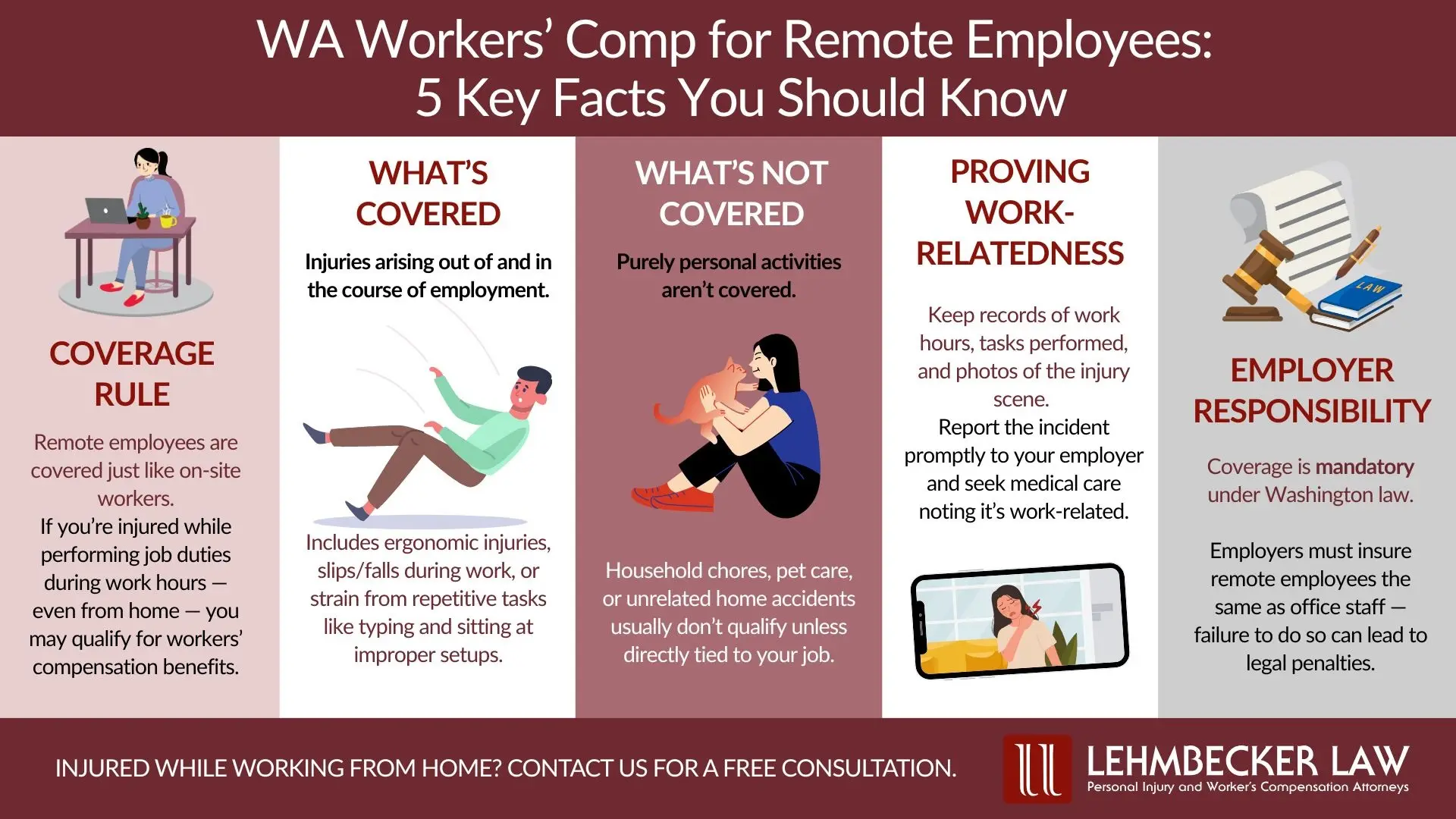
Workers' compensation for remote employees in Washington State operates under the same basic principles as traditional workplace coverage, but with unique issues not seen in traditional employment settings. Remote workers are covered when injuries occur "arising out of and in the course of employment", meaning during work hours while performing work-related activities, even when working from home.
The Washington State Department of Labor & Industries (L&I) applies the same standards to remote work injuries as to traditional workplace accidents, but proving the work connection can be more challenging without the controlled environment of a traditional office.
Yes, Washington State law requires workers' comp coverage for remote employees. If your business has employees working from home, you must provide the same workers' compensation insurance coverage as you would for on-site workers. This is not optional — it's a legal requirement under Washington law.
Remote employees are entitled to workers' comp benefits regardless of where they work, whether that's:
The location doesn't determine coverage, but the employment relationship does. As long as someone is your employee (not an independent contractor), they must be covered under your workers' compensation policy.

Remote employees can suffer various types of work-related injuries that qualify for workers' compensation benefits:
Extended computer use without proper ergonomic setup can lead to serious conditions, including:
These conditions often develop gradually and can be severe enough to require extensive medical treatment and time away from work. If you're experiencing any of these work-related injuries, it's important to seek medical attention and document the connection to your work duties.
Home environments present unique hazards that can cause serious injuries:
These types of premises liability injuries can be particularly challenging to prove in a home setting, but they're still covered when they occur during work activities.
Remote workers may be injured while performing specific job duties:
Work-related stress, anxiety, or depression that develops may qualify for workers' compensation coverage in some cases, particularly when related to the following:
Understanding the personal comfort doctrine is crucial for remote workers. This legal principle recognizes that certain non-work activities during the workday are still considered part of normal working conditions. For remote employees, this means injuries occurring during activities like:
These activities may still be covered under workers' compensation, even though they're not directly work-related tasks. The key question is whether the activity was reasonable and incidental to your work duties.
However, injuries during purely personal activities, such as walking the dog, doing household chores, or exercising during work hours, are typically not covered unless they are somehow connected to your work responsibilities. Understanding these distinctions is crucial when filing a workers' comp claim as a remote employee.

While workers' comp for remote employees provides broad protection, certain injuries and situations typically aren't covered:
Conditions that existed before your employment or weren't aggravated by work activities generally aren't covered, unless your work duties significantly worsened the condition. If your claim involves a pre-existing condition, our experienced Washington workers' comp lawyers can help establish the work-connection.
Injuries during purely personal tasks, such as household chores, pet care, or recreational activities, usually don't qualify for coverage, even if they occur during work hours.
Injuries resulting from fooling around, violating safety policies, or engaging in activities specifically prohibited by your employer typically aren't covered.
Injuries occurring while under the influence of alcohol or illegal drugs are generally excluded from workers' compensation coverage.
Accidents caused by existing home hazards that aren't connected to your work setup (like faulty wiring or broken stairs) usually won't be covered unless your employer required you to work in that specific location.

The biggest challenge for remote workers is proving their injury is work-related. If you're injured while working from home, taking these steps immediately can strengthen your workers' compensation claim:
Get medical care as soon as possible, even for seemingly minor injuries. Tell your healthcare provider that you believe your injury is work-related and ask them to document this connection in your medical records.
Maintain detailed records showing your regular work hours, when the injury occurred, what work tasks you were performing, and whether you were "on the clock" at the time of injury.
Immediately after an injury, take photos of the accident scene and document any equipment involved (broken chair, loose cables, etc.). Don't alter your workspace until documented, and keep all medical records and treatment documentation.
Notify your employer about the injury immediately, preferably in writing, and include the date and time of injury, a detailed description of how it occurred, what work tasks you were performing, and any witnesses (even if family members present).
Washington requires you to report workplace injuries within one year, but earlier notification strengthens your case and ensures you don't miss important deadlines. Learn more about proper claim reporting procedures in our comprehensive guide.
Submit your workers' compensation claim to L&I or your employer's self-insured program. Include all relevant documentation and be as detailed as possible about how your injury occurred during work activities.
Remote employees who suffer work-related injuries are entitled to the same workers' compensation benefits as traditional office workers:
Your workers' comp claim covers all necessary medical treatment related to your injury, including doctor visits, physical therapy, prescription medications, and any required medical equipment.
If your injury prevents you from working, you can receive time-loss benefits ranging from 60% to 75% of your gross wages, depending on your family situation.
If your injury prevents you from returning to your previous remote position, L&I may provide retraining services to help you develop new skills for alternative employment.
For injuries that result in lasting impairment, you may be entitled to permanent partial disability awards or, in severe cases, lifetime pension benefits.

It's crucial to understand that workers' comp for remote employees only applies to actual employees, not independent contractors. This distinction is critical:
Some employers incorrectly classify remote workers as independent contractors to avoid workers' comp obligations. This can lead to:
If you're unsure about your classification as a remote worker, experienced workers' compensation attorneys can help determine if you've been properly classified and are entitled to workers' comp benefits. Misclassification is a serious issue that can leave workers without proper injury protection.

Navigating workers' compensation claims as a remote employee requires experienced legal guidance. Our WA workers' comp attorneys understand the unique challenges remote workers face and can help you:
We've helped countless remote workers throughout Washington State secure the benefits they need to recover from workplace injuries and return to productive employment. Whether your claim involves complex injury documentation, disputes over work-relatedness, or workers' compensation denials, our experienced team knows how to build strong cases for remote employees.
The rise of remote work has created new challenges in workers' compensation law, but your right to benefits remains the same regardless of where you perform your job duties. If you've been injured while working from home, don't let uncertainty about coverage prevent you from seeking the benefits you deserve.
Contact us today for a free consultation with a Seattle workers' compensation lawyer who understands remote work injury claims. We'll evaluate your case, explain your options, and fight to ensure you receive full compensation for your work-related injury.

Don't let uncertainty about remote work coverage prevent you from seeking the workers' compensation benefits you deserve. Lehmbecker Law can evaluate your case and help you file a successful claim.
Remote work injury claims face unique challenges, but you don't have to navigate them alone. Our experienced Washington workers' compensation attorneys understand the complexities of proving work-relatedness for home office injuries.


Yes, workers' compensation covers remote employees in Washington State when injuries occur during work hours while performing job-related tasks. The location doesn't matter. What matters is that you're acting in the course and scope of your employment when the injury happens.
Your employer is incorrect. Washington law requires workers' compensation coverage for all employees, including remote workers. If your employer denies coverage based on your remote work status, contact an experienced workers' compensation attorney immediately.
Document everything: your work schedule, what tasks you were performing, photos of the injury scene, witness statements if available, and seek immediate medical care. Tell your healthcare provider the injury is work-related and ask them to document this connection.
No, independent contractors are generally not covered by workers' compensation, regardless of whether they work remotely or on-site. However, many workers are misclassified as contractors when they should be employees with full workers' comp protection.
The most common remote work injuries include ergonomic injuries (carpal tunnel, back pain), slip and fall accidents, eye strain from poor lighting, and repetitive stress injuries from inadequate home office setups.
Most health insurance policies exclude coverage for work-related injuries, expecting workers' compensation to provide this coverage. This is why workers' comp protection is crucial for remote employees.
In Washington, you must report workplace injuries within one year of the accident. However, report injuries to your employer immediately and file your L&I claim as soon as possible to strengthen your case.
No, Washington law prohibits employers from retaliating against employees who file workers' compensation claims, regardless of where they work. If you face retaliation, you may have additional legal claims against your employer.