There is no fee unless we win!
EN

- EN
- ES


A car accident is always stressful. But when you’re "on the clock" for work, it becomes much more confusing.
Are you supposed to call your boss first or 911? Does your employer’s insurance cover the damage, or does yours? If you’re injured, do you file for workers’ compensation, or do you sue the driver who hit you?
The answer is often both.
This situation, known as a "crossover case", involves two different areas of the law: Workers’ Compensation and Personal Injury. Most law firms only handle one. At Lehmbecker Law, we have built our practice on helping people with both types of cases for 40 years.
This article explains who is liable after a car accident on the clock and what steps you must take to protect your rights.
After a work-related car crash, you may be able to open two separate claims to recover compensation.

If you are an employee (not an independent contractor) and were injured while performing your job duties, you are almost always eligible for workers' compensation benefits.
Washington’s workers’ compensation system is "no-fault". This means:
However, workers’ comp does not pay you for pain and suffering or the full value of your lost earning capacity and other economic losses.
If another person’s negligence caused your accident (for example, another driver ran a red light and hit you), you have the right to file a separate personal injury claim against them.
This "third-party claim" is filed against the at-fault driver’s insurance company. Unlike a workers' comp claim, a personal injury claim can provide compensation for:
This is a critical distinction. Your workers' compensation claim pays your medical bills and a portion of your wages, while your personal injury claim is meant to cover all the other ways the accident has harmed your life.

This is one of the most common questions. In Washington, an employer can be held legally responsible for their employee's actions under a doctrine called "Respondeat Superior", which means "let the master answer".
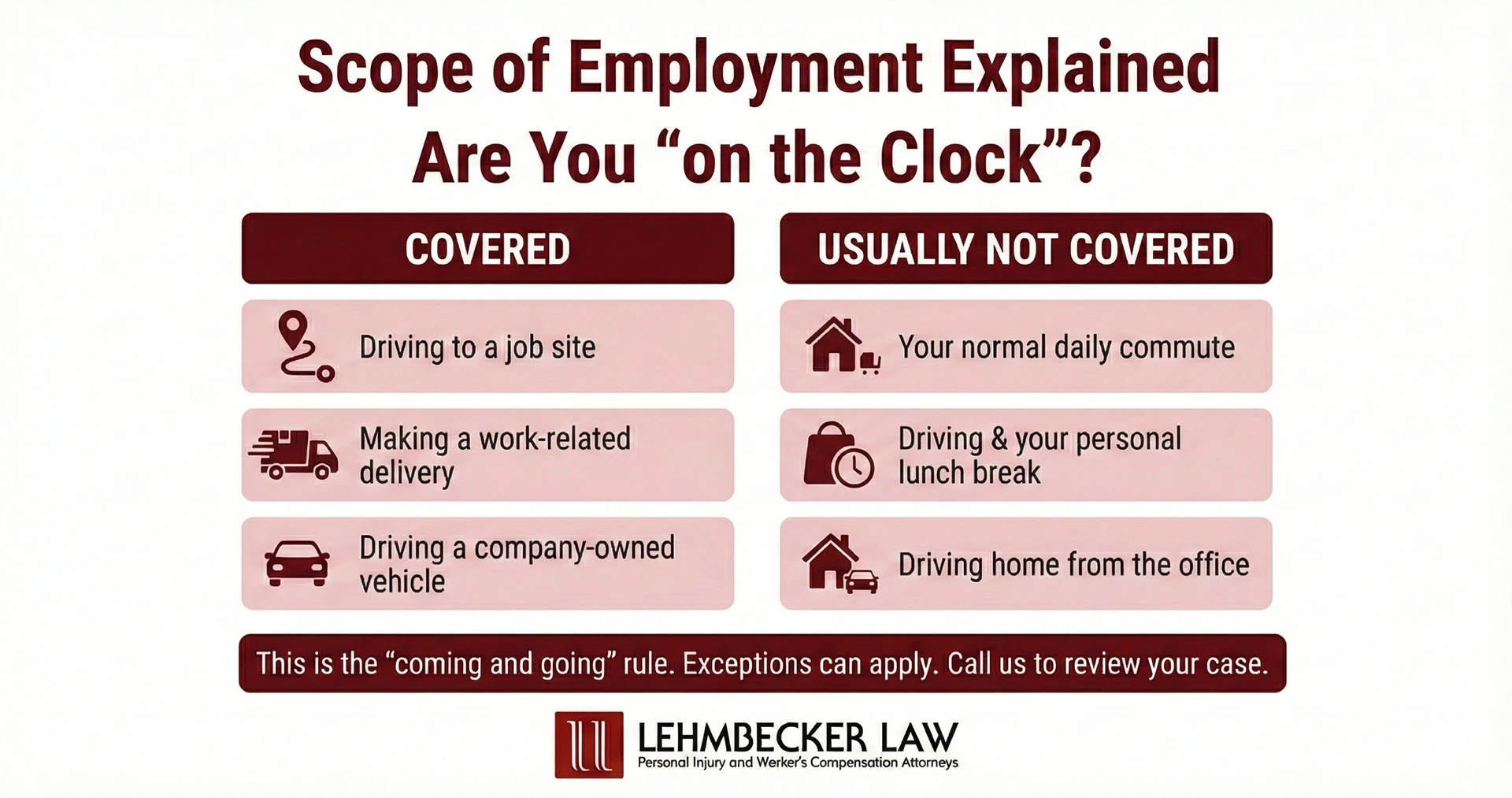
For this to apply, the employee must have been acting within the "scope of employment" when the accident occurred.
You are generally considered to be in the "scope of employment" if you were performing a task for your employer's benefit.
Examples include:
Your daily commute between your home and your primary workplace is typically not considered "on the clock". This is known as the "coming and going" rule.
If you get in an accident during your usual commute, it is usually treated like any other personal auto accident. However, there are exceptions. If your employer requires you to use your vehicle for work (like traveling between different work sites) or if you are "on call", your commute may be covered.
Yes, the vehicle you were driving affects which insurance policies are involved.
If you are in a company-owned vehicle, your employer’s commercial auto insurance policy is typically the primary insurance for liability and damages. Your workers' compensation claim still covers your personal injuries.
This is where it gets complicated. If you were driving your own car for a work-related task and caused an accident, the other driver may file a claim against your personal auto insurance and your employer’s policy. Your personal policy is usually primary, but your employer’s commercial policy may act as secondary coverage if the damages exceed your policy limits.
If another driver hits you while you're in your personal car, you would file a claim against their insurance, and your workers' comp claim would cover your injuries.
The biggest mistake you can make is trying to handle these claims on your own or hiring separate law firms. Insurance companies often try to point fingers at each other to avoid paying, leaving you caught in the middle.
Because Lehmbecker Law handles both Personal Injury and Workers' Compensation cases, our team manages the entire process.
If you were injured in a car accident while on the clock, do not wait to call for help. Contact Lehmbecker Law today for a free consultation to discuss your case.

Not sure if your accident counts as "on the clock"? Use our 40 years of Washington case law experience to determine if you qualify for L&I benefits.


You should report the accident to your employer to start a workers' compensation claim for your medical bills and lost wages. If another driver was at fault, you can also file a separate personal injury claim against them for pain and suffering.
Usually, no. The workers' compensation system is an "exclusive remedy", meaning you give up the right to sue your employer for the injury in exchange for no-fault benefits. The only exception is in rare cases where the employer intentionally caused your injury.
If you were in a company-owned vehicle, your employer's commercial auto insurance policy is the primary liability insurer. Your workers' compensation claim covers your own injuries.