There is no fee unless we win!
EN
  • EN
  • ES

Top 5 Common Construction Site Accidents in Washington and What to Do If You're Injured

Table of Contents
    Top 5 Common Construction Site Accidents in Washington and What to Do If You're Injured

    A ladder rung gives way. A load swings wider than expected. A trench wall shifts before anyone can react. These moments happen fast, and they happen often on Washington job sites.

    Knowing the most common construction accidents in Washington helps workers recognize hazards before they cause harm and understand their options if they're hurt anyway. At Lehmbecker Law, our experienced construction accident attorneys work with injured tradespeople across the state and know how confusing it can be to sort out what benefits apply and who's responsible.

    The Most Common Construction Accidents in Washington State

    Construction consistently ranks among Washington's most hazardous industries. The table below summarizes the latest available data before we break down each hazard.

    Hazard Recent Data Point
    Falls More than 1,600 Washington workers are injured by falls every year; the leading cause of death in state construction (L&I)
    Struck-By / Caught-Between Struck-by incidents statewide more than doubled in 2024, with construction among the hardest-hit industries (L&I SHARP, 2024 Work-Related Deaths)
    All Construction Fatalities 1,032 construction and extraction worker deaths nationwide in 2024, including 370 from falls (BLS)
    WA Workplace Deaths, All Industries 74 Washington workers died on the job in 2024 (L&I SHARP, 2024 Work-Related Deaths)

    1. Falls from Heights

    Falls are, by a wide margin, the single biggest driver of serious injury and death on Washington construction sites. L&I reports that more than 1,600 workers are hurt statewide in falls every year. They happen from roofs, scaffolding, ladders, unprotected floor openings, and elevated platforms.

    Common causes:

    • Missing or improperly anchored guardrails;
    • Unsecured or poorly maintained harnesses;
    • Rushed work near unprotected floor or roof openings;
    • Unstable or damaged ladders.

    Common injuries: spinal cord damage, traumatic brain injuries, and fractures requiring months of recovery.

    2. Scaffolding Collapses

    Scaffolding failures put every worker on or near the structure at risk at once, which is why they tend to produce multiple injuries rather than a single one.

    Common causes:

    • Overloading a platform beyond its rated capacity;
    • Damaged, mismatched, or substandard components;
    • Improper anchoring or bracing;
    • Weather, wind, rain, or ice destabilizing an otherwise sound structure.

    When a general contractor or scaffolding subcontractor cuts corners on inspection or assembly, the resulting collapse is often traceable to a specific, provable failure.

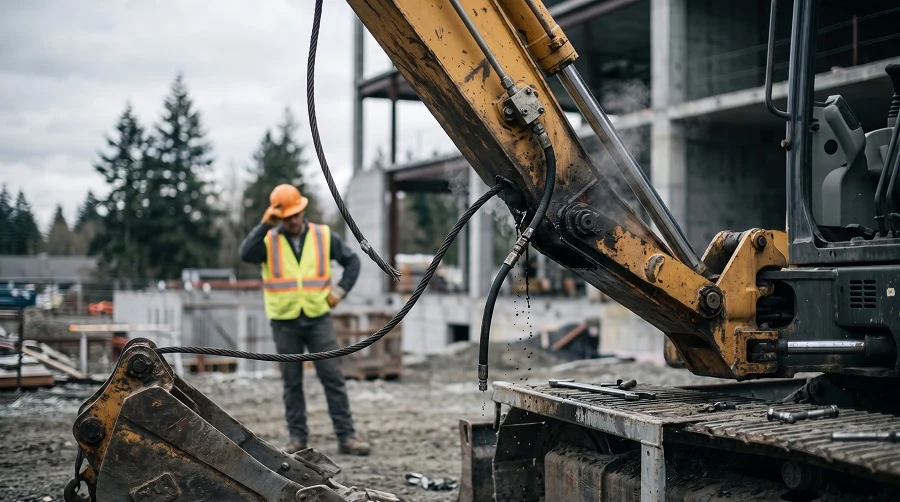
    3. Equipment Malfunctions

    Construction relies on forklifts, cranes, nail guns, table saws, augers, and dozens of other powered tools. Any one of them can cause a severe injury when it fails or is used improperly.

    Common causes:

    • Deferred maintenance;
    • Missing safety guards;
    • Manufacturing defects;
    • Operators who weren't properly trained on the specific machine.

    Common injuries: crush injuries, amputations, and lacerations. Because an equipment rental company, manufacturer, or maintenance contractor may share responsibility, these cases often involve more than a standard workers' comp claim.
    3. Equipment Malfunctions

    4. Electrocutions

    Contact with electricity remains one of construction's deadliest hazards. It's one of OSHA's "Focus Four" leading causes of construction fatalities. Construction workers also face this risk far more than most other trades: federal researchers have found they're roughly four times more likely to be electrocuted on the job than workers in all other industries combined.

    Common causes:

    • Overhead power lines
    • Exposed or damaged wiring
    • Faulty extension cords
    • Improperly grounded equipment

    Electricians and workers using power tools near wet conditions face elevated risk, but electrocution hazards touch nearly every trade on a job site. Even a non-fatal shock can cause burns, cardiac complications, and lasting nerve damage.

    5. Struck-By and Caught-Between Accidents

    Falling tools, swinging loads, reversing vehicles, and collapsing trenches all fall under this category. L&I's most recent fatality data shows this hazard is trending in the wrong direction, with statewide struck-by incidents more than doubling in 2024 and construction among the most affected industries.

    Common causes:

    • Falling or flying debris
    • Swinging equipment or loads
    • Reversing vehicles or machinery
    • Trench or excavation collapses

    Struck-by injuries range from bruises to fatal head trauma. Caught-between accidents tend to cause severe crush injuries, since there's often no way to brace for impact.

    What to Do If You're Injured on a Construction Site

    The moments and days after a construction accident matter, both for your recovery and for any claim you may eventually file:

    1. Get medical attention right away, even if the injury seems minor. Some injuries, like internal trauma or nerve damage, aren't obvious immediately.
    2. Report the accident to your supervisor or employer as soon as possible. Washington law requires prompt reporting to preserve your workers' comp rights.
    3. Document the scene with photos of the hazard, your injury, and any equipment involved, if it's safe to do so.
    4. Get contact information for witnesses who saw what happened.
    5. Avoid giving a recorded statement to an insurance adjuster before speaking with an attorney.
    6. Keep copies of medical records, pay stubs, and any correspondence related to the accident.

    Workers' Comp Isn't Always the Whole Picture

    Most injured construction workers in Washington will file a claim through L&I or a self-insured employer, which generally covers medical treatment and partial wage replacement regardless of fault. Washington law also generally prevents you from suing your own employer directly for a workplace injury, since workers' comp is the exclusive remedy in that relationship.

    That doesn't mean workers' comp is the end of the story. On a construction site, multiple companies are usually present at once, and a separate third-party injury claim may be available in addition to your L&I benefits.

    Workers' Comp (L&I) Third-Party Claim
    Applies To Your direct employer A negligent party who isn't your employer or a coworker
    Fault Required? No Yes, negligence must be shown
    Covers Medical bills, partial wage replacement Full lost wages, pain and suffering, and more
    Common Defendants N/A Subcontractors, equipment manufacturers, general contractors, property owners

    Common third-party scenarios on construction sites include:

    • A subcontractor's negligence caused your injury, and they weren't your employer.
    • Defective or poorly maintained equipment failed, pointing to a manufacturer or rental company.
    • A general contractor failed to enforce basic site safety standards.
    • A property owner ignored a known hazard unrelated to the construction work itself.

    Sorting out liability on a multi-contractor job site can take an extensive investigation, which is where an experienced construction accident lawyer's involvement often makes the biggest difference.

    Get Help After a Washington Construction Accident

    A construction site injury can upend your income and your recovery at the same time. The skilled attorneys at Lehmbecker Law will use their advanced knowledge to investigate what caused your accident, guide you through your L&I claim, and pursue any negligent third party so you get every dollar of compensation you're entitled to. Contact us today for a free consultation. We work on a contingency basis, so there's no fee unless we recover for you.

    Injured on a Washington Job Site? Talk to Us First.

    Before you sign anything or accept a quick settlement offer, talk to a construction accident attorney who can explain what your injury is actually worth. Lehmbecker Law reviews job site accidents across Washington State at no upfront cost to you.

    Get a Free Case Evaluation

    Larry A. Lehmbecker
    Firm Founder, Larry Lehmbecker, has nearly 40 years of experience fighting for the injured in Washington State. He is always eager to share his knowledge to help those in need.
    Contact Lehmbecker Law Today
    Contact Lehmbecker Law Today
    Our attorneys and paralegals have decades of experience to help ensure you receive appropriate treatment for your injuries.
    Our attorneys and paralegals have decades of experience to help ensure you get the proper treatment for your injuries.
    Contact UsContact Us

    Latest News & Insights

    Construction Site Injury Rates in Washington: A 5-Year L&I/OSHA Data Study

    Washington construction injury rates over 5 years: L&I and OSHA data on fatalities, industry comparisons, common hazards, and options for injured workers.
    Updated
    October 12, 2026
    October 14, 2026

    Is a Landlord Liable for a Tenant's Dog Bite in Washington?

    A landlord usually isn't liable for a tenant's dog bite in Washington, but real exceptions exist. See when you can sue, and how our WA attorneys can help.
    Updated
    October 8, 2026
    October 12, 2026

    6 Things Insurance Adjusters Won't Tell You After a Bellevue Crash

    Insurance adjusters won't always explain your Bellevue car accident claim's true value. Learn 6 things they may leave out, and how Lehmbecker Law can help.
    Updated
    September 18, 2026
    October 7, 2026

    No items found.